For the complete documentation index, see llms.txt. This page is also available as Markdown.

Form flows

The Form flows tab lets you configure multi-step form sequences for complex data collection workflows.

A form flow guides a user through a sequence of forms, like a wizard. Use it to break a single task into several screens, to branch based on user input (for example, showing different follow-up forms for approved and denied requests), and to run actions when a step opens, completes, or the user goes back. A form flow is normally linked to a BPMN user task via a process link.

Each form flow definition is JSON against a schema. The form flow editor has two tabs that work on the same definition: a JSON editor (the default) with autocomplete and validation, and a visual Editor (beta) that shows the steps, transitions, and actions as a form-based UI.


Configuring form flows

1

Expand Admin in the left sidebar

2

Click Cases under the Configuration section

3

Click a case definition to open it

4

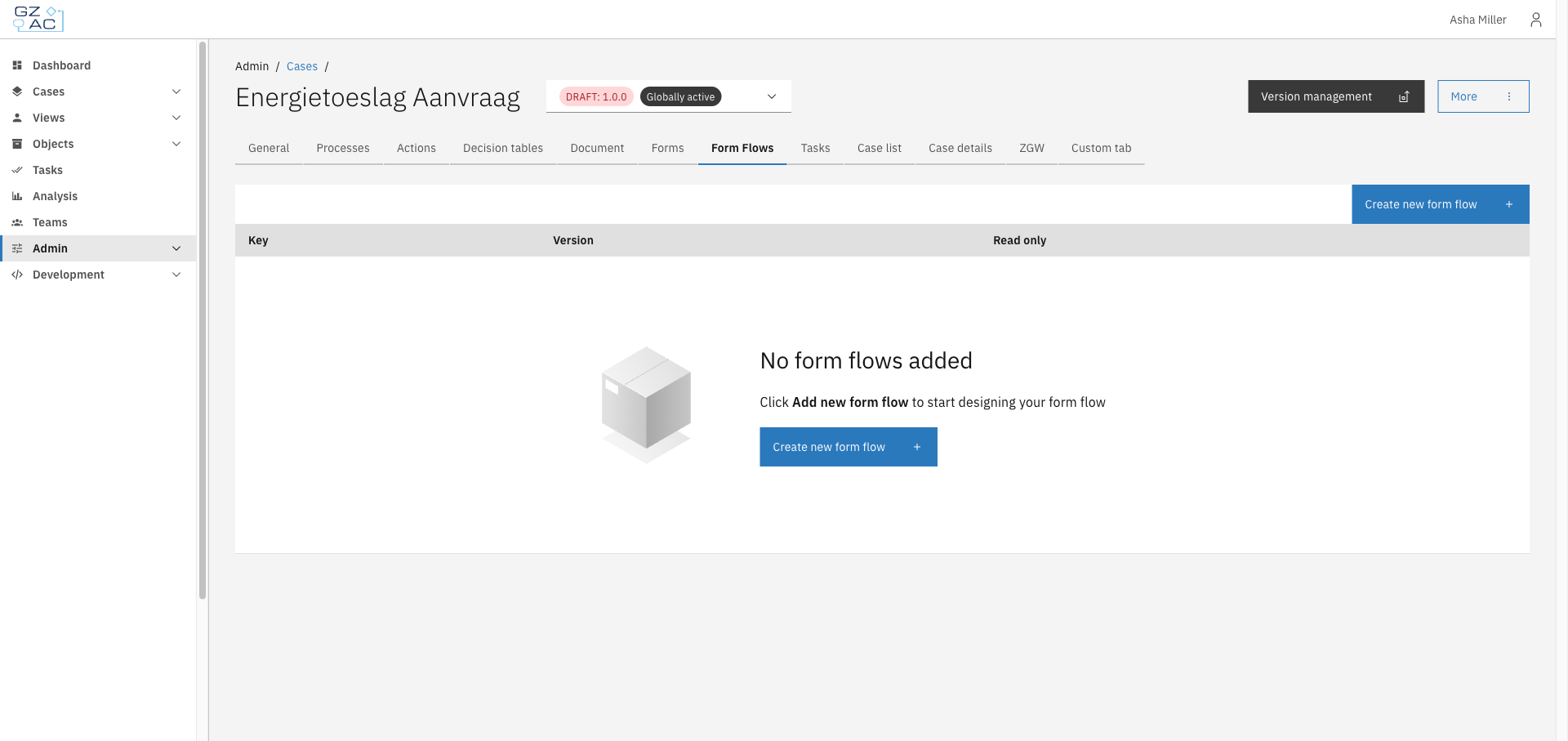
Click the Form Flows tab

Form Flows tab showing the empty state
The Form Flows tab lists all form flow definitions configured for the case.
Adding a form flow

1

Click Create new form flow

2

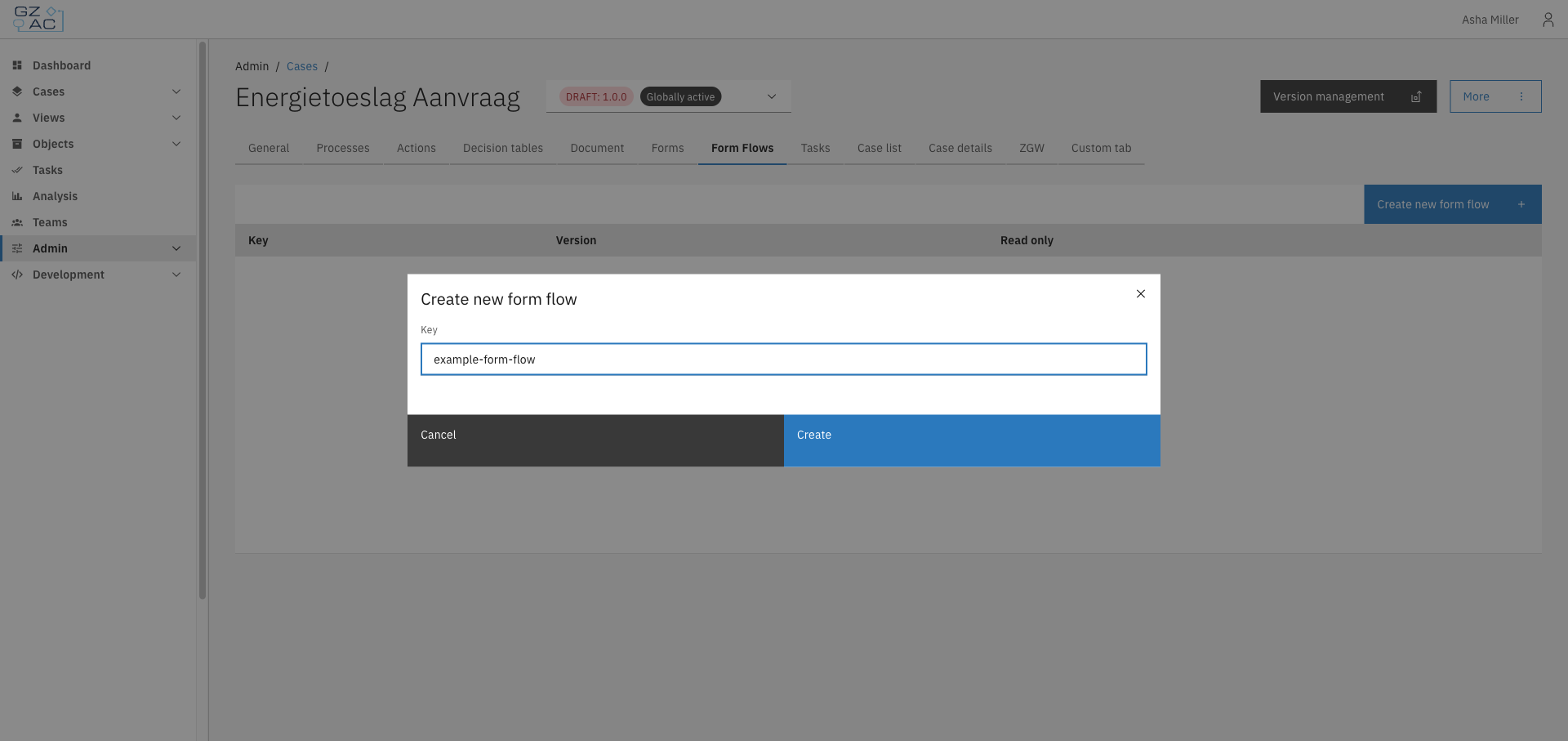
Enter a unique Key for the form flow

Create new form flow modal with the key field filled in
The key identifies the form flow definition and is used to link it from a process.
3

Click Create

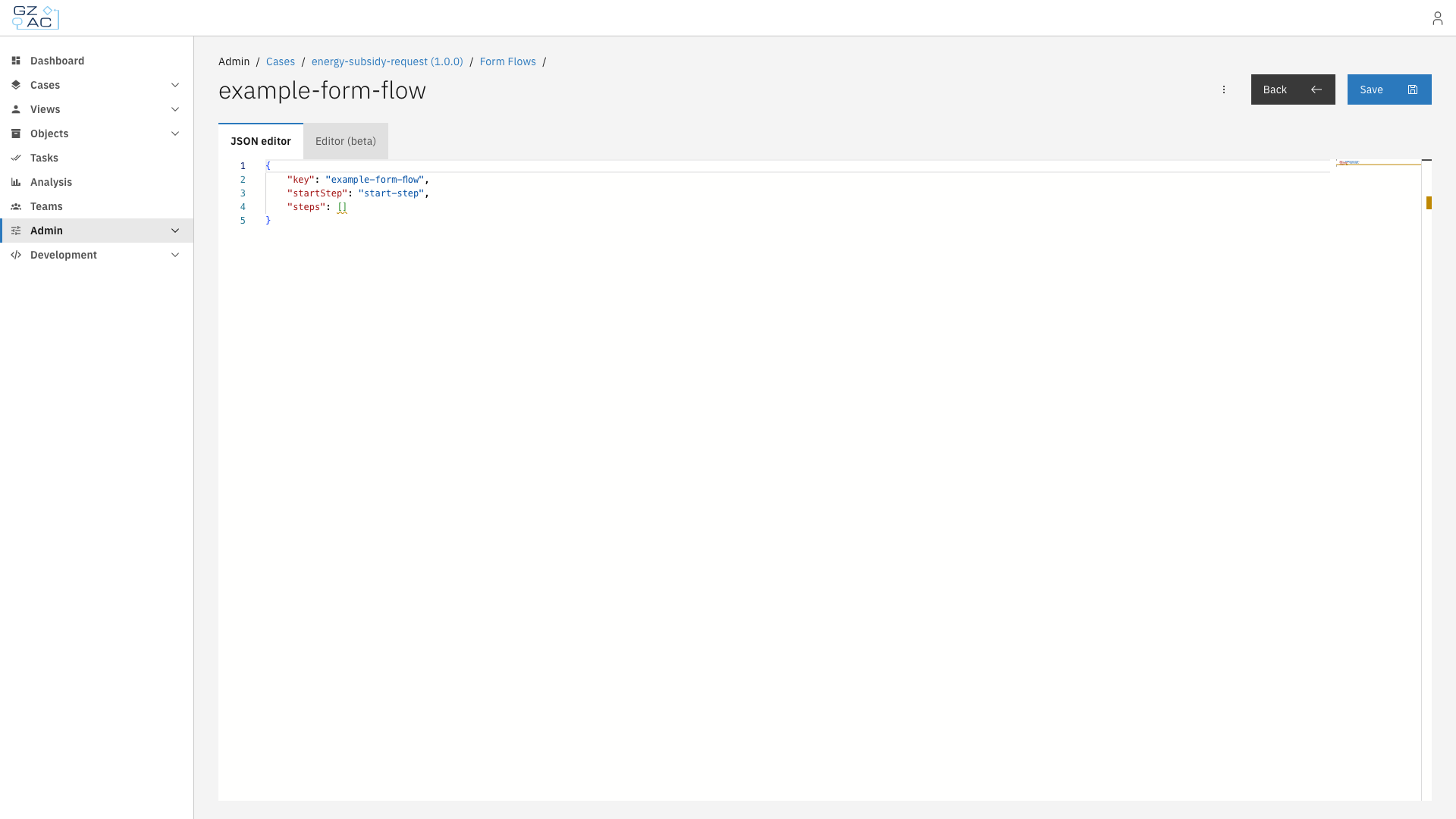
You're taken to the form flow editor, which opens on the JSON editor tab with a minimal default definition: a single start-step and an empty steps array.

Form flow editor showing the default JSON stub
A newly created form flow starts with an empty steps array.
Editing in the JSON editor

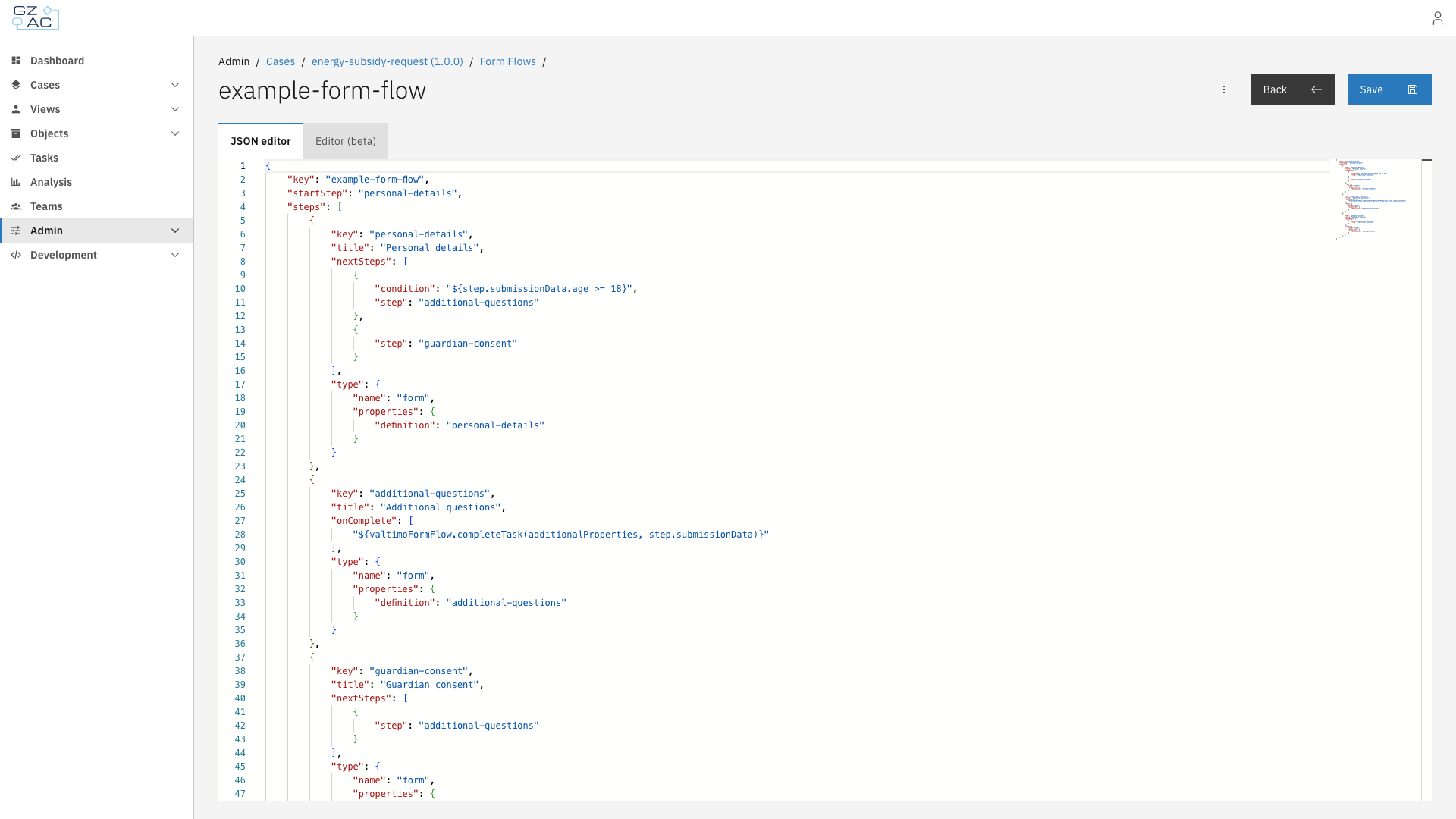
Add and configure steps directly in the JSON editor. The editor validates your changes against the form flow schema as you type and offers autocomplete for property names and values.

Form flow editor with multiple steps, a conditional transition, and an onComplete action
A form flow with a personal-details step that branches to one of two follow-up steps depending on the submitted age, and completes the surrounding task once finished.
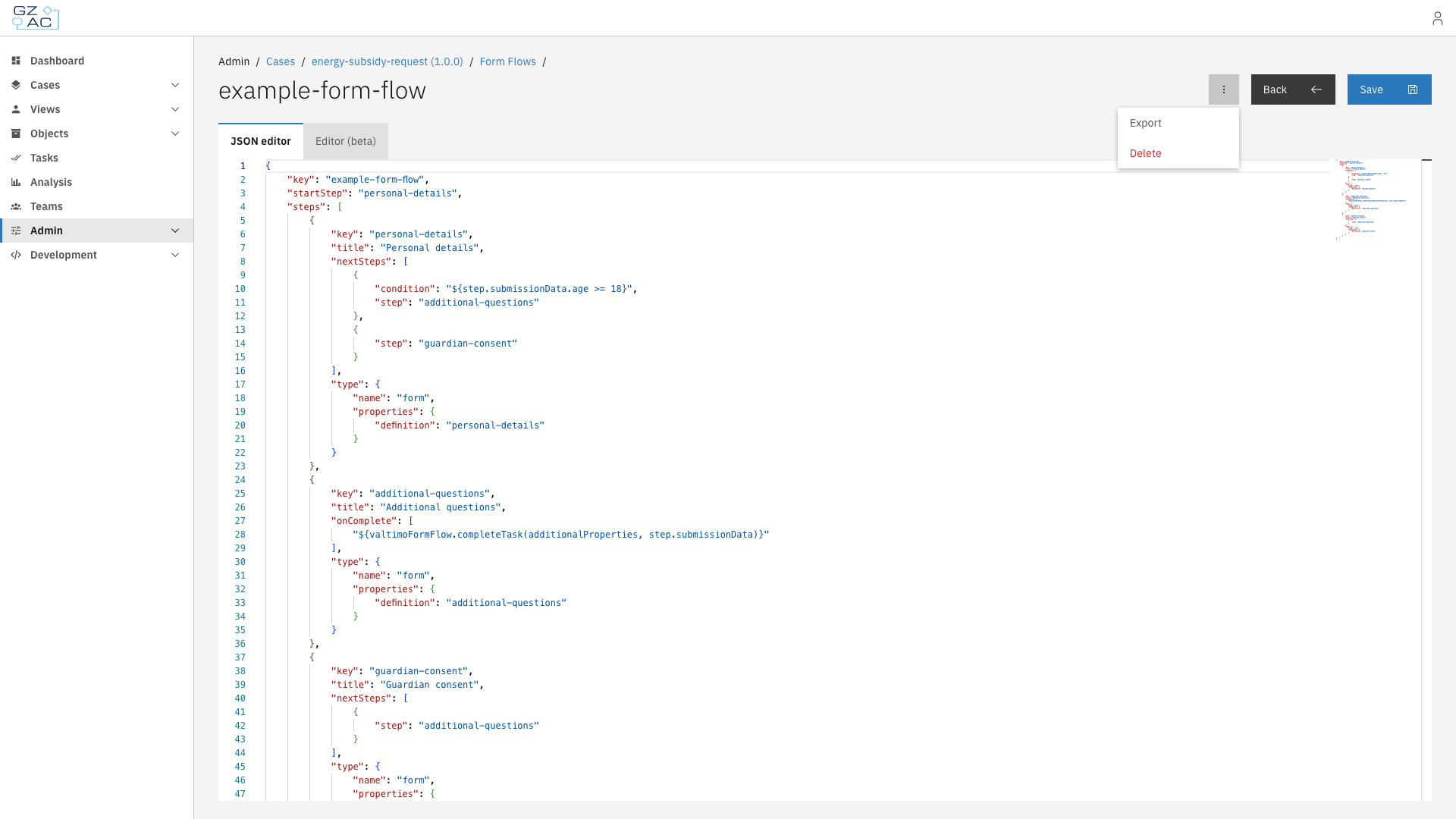
Click Save once the JSON is valid (the button is disabled otherwise). Use the overflow menu (⋮) to Export the definition as a JSON file or Delete the form flow.

Editor overflow menu with Export and Delete options
Export downloads the form flow definition as a JSON file; Delete removes it.

Form flow definition fields

Field
Description

key

Identifier of the form flow definition. Overwritten with the key from the URL when you save, so it doesn't need to be edited manually.

startStep

The step shown first when the form flow starts. Must match the key of one of the entries in steps.

steps

All steps in the form flow. At least one step is required, and step keys must be unique.

Step fields

Field
Description

key

Identifier of the step, referenced from startStep and from nextSteps.

title

Optional. Label shown in the breadcrumb trail at the top of the form flow (when breadcrumbs are enabled). Falls back to a translation key if left empty.

type

What is rendered for the step — see step types below.

nextSteps

Where the user can go after completing the step. Entries are evaluated in order; the first one whose condition is true is taken. At most one entry may omit its condition — that one is the default. If no entry matches, the form flow ends.

onOpen

Actions run when the user opens the step.

onBack

Actions run when the user navigates back from the step.

onComplete

Actions run when the user completes the step (submits the form).

onOpen, onBack, and onComplete are each an array of SpEL expressions wrapped in ${...}, evaluated in order. Common examples:

Step types

type.name

type.properties

Description

form

{ "definition": "<form key>" }

Renders a Form.io form. definition must match the key of a form defined for the case (see Forms).

custom-component

{ "componentId": "<component id>" }

Renders a custom Angular component instead of a form, identified by componentId as registered in the frontend.

Next step fields

Field
Description

step

The key of the step to transition to. Must match one of the entries in steps.

condition

Optional. A SpEL expression wrapped in ${...} evaluated against the current step's submission data, e.g. ${step.submissionData.personalDetails.age >= 21}. Omit to make this entry the default transition.

Editing in the visual editor (beta)

The Editor (beta) tab offers a visual alternative to writing the JSON by hand. Both tabs work on the same definition, so you can switch between them at any time.

Visual form flow editor with a step list and the configuration of the selected step
The visual editor shows the steps of the flow in a sidebar and the configuration of the selected step next to it.

The left panel lists the steps of the flow; Add step adds a new one. Selecting a step shows its configuration on the right:

  • Step details — The key identifies the step; renaming it automatically updates the start step and every transition that references it. The optional title is shown in the breadcrumb trail while a user walks through the form flow. The type determines what the step shows: for a form step, the Form dropdown lists the forms of this case definition; for a custom-component step, the Component ID dropdown lists the custom components registered by the implementation (the custom-component type is unavailable when none are registered).

  • Start step — The step where the form flow begins carries a Start step tag. Any other step can be made the start step with the Make start step button.

  • Navigation — Transitions define where the user can go after completing the step. Each transition points to another step and can have a SpEL condition. Transitions are evaluated from top to bottom — the first one whose condition holds is taken, and a transition without a condition is the default. The order can be changed with the arrow buttons.

  • Actions — Expressions that run when the step opens, when it is completed, or when the user navigates back. The Add action menu lists the registered form flow functions with their parameters, next to the option to write a blank expression.

Add action menu listing the registered form flow functions
The Add action menu lists the registered form flow functions, such as valtimoFormFlow.completeTask.

The How do expressions work? link opens a help dialog explaining conditions and actions, including exactly which data is available in additionalProperties for this application.

Help dialog explaining how expressions work
The help dialog documents the expression syntax and the available context data.

The editor validates the definition while editing — duplicate step keys, a missing start step, transitions to unknown steps, and multiple default transitions are reported — and warns when leaving the page with unsaved changes.

Managing existing form flows

Form flows already created for the case appear in the list on the Form Flows tab.

Form Flows tab showing a list with one form flow
Existing form flows are listed with their key, version, and read-only status.

Use the overflow menu on a row to Edit (opens the editor) or Delete the form flow.

Row overflow menu with Edit and Delete options
Edit and Delete options for a form flow in the list.

Deleting a form flow requires confirmation.

Delete confirmation dialog for a form flow
Confirm deletion of a form flow.

Last updated